
About the Book - Finding Inspiration in Every Turn
After the great success of the first edition in 2015, which quickly sold out, the author Sharon Givoni is returning with a new edition of “Owning It: A Creative’s Guide to Copyright, Contracts and the Law”.
The coverage in the book arises out of the author’s 30 years experience in legal practice. Not a legal book in the usual sense, renowned Australian intellectual property lawyer Sharon Givoni explains in ‘plain English’ how the law applies to creative industries. Packed with real-life case studies and user-friendly flowcharts and tables that simplify legal terms, processes and procedures, Owning It demystifies the law for creatives.
Why was the book written?
This book first came to be after the author gave a talk for a group called Creative Womens’ Circle in Melbourne. The talk was intended to provide creatives with a foundational grasp of the law, including matters such as copyright, trade marks and contracts. We were overwhelmed with the attendance numbers and positive response and realised there was a real and significant gap in the marketplace for creatives who want to understand how the law works. Those who work in the creative field often wear a multitude of hats – they are business owners, book-keepers, marketing managers, social media managers, distributors, employers, and trend analysts and market researchers. With such a mountain of responsibility, the author wanted to take one worry off the creative plate and empower creatives with a strong legal grasp of their work. Whilst nothing can ever replace a lawyer, this should not stop creatives from having a basic understanding of something that affects every step and every facet of their creative journey.
What is covered in the book?
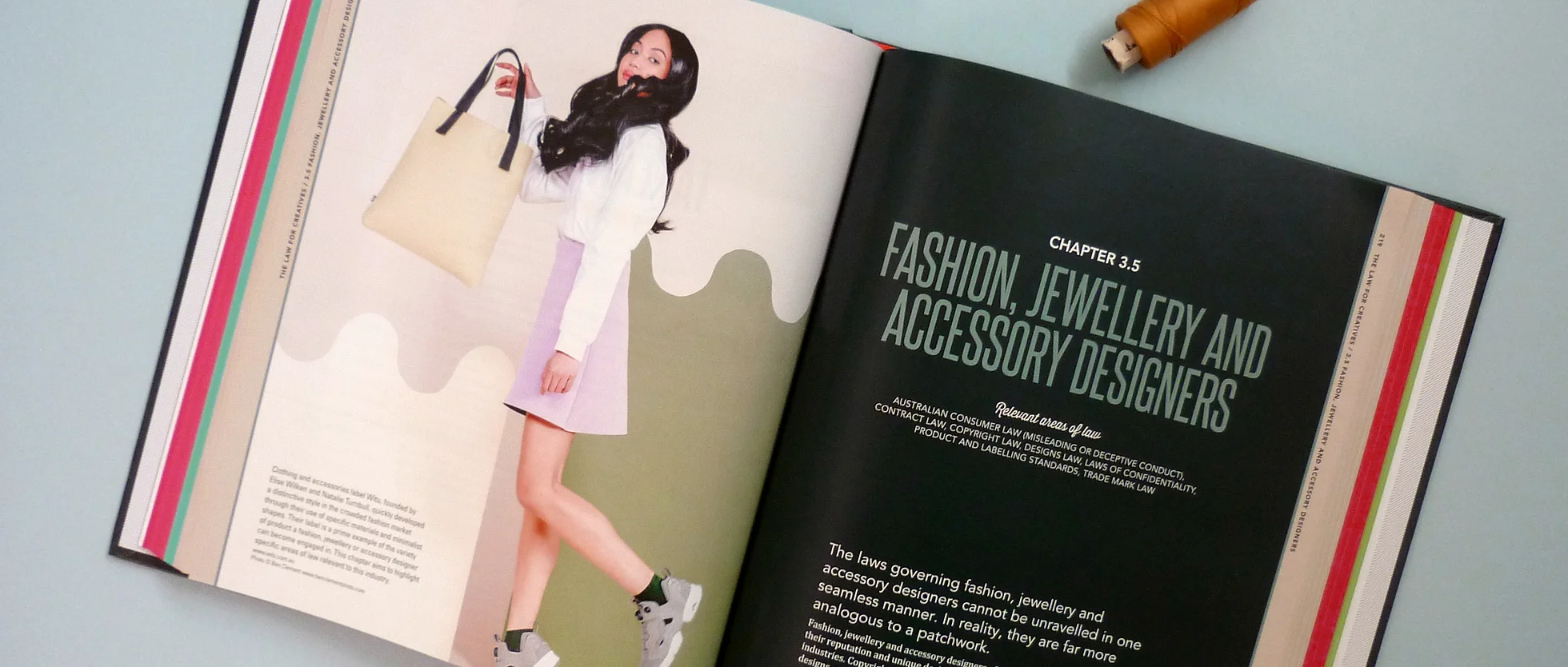
The book is divided into two main parts. The first part sets out the foundational basics of copyright law, trade mark law, design law, confidentiality and trade secrets, patent law, as well as how these various and distinct areas interact. The second part of the book addresses the issues relating to specific industries, including architecture, photography, jewellery making, fashion design, NFT art, self-publication, blog and website design, social media content creation and the protection of ideas, to name a few. What this all means it that the book will open you to your various rights. Creatives usually know they have rights, but often cannot pin-point what those exact rights are. However, this book does not cover all legal matters related to businesses, such as employment, superannuation or tax laws.
Outline of the Book
- Part 1 outlines key areas of intellectual property including Copyright, Ownership, Trade Marks, Moral Rights, and Misleading & Deceptive Conduct
- Part 2 is all about creating work that abides by the law, and talks about photography, reproducing brand & trade marks in your work, cultural icons, parody & satire, and censorship
- Part 3 breaks down specific areas of law for different creative practices
- Part 4 explores the business side of creativity, looking at digital marketing, business structures,money, insurance, naming your business, contracts & agreements, model releases, Creative Commons, collecting societies & resale royalty rights, and running competitions & promotions
- Part 5 encourages you to be proactive in the protection of your intellectual property, and looks atenforcing your rights, the defences of copyright infringement, working with lawyers and what to expect of a legal outcome

Who will this book benefit?
In this day and age, most businesses in some way exploit, create, consume or use intellectual property. Creative businesses in particular are all based on the expression of unique ideas and it is this expression that helps a business stand out in saturated markets. This book can help creatives to identify their valuable intellectual property and provide them with ways to protect it. In fact, many have given us feedback that the book has not only empowered them with a better understanding of how the law affects them and their work but has also directly shaped how they run and approach their businesses. In the words of Esther Dyson: “Owning the intellectual property is like owning land: You need to keep investing in it again and again to get a payoff; you can simply sit back and collect rent.” People who will benefit include: business owners, artists, mural painters, animators, photographers, authors, copywriters, ghost writers, publishers, jewellery makers, fashion designers, interior designers, architects, landscape designers, furniture designers, ceramicists, musicians, software developers, social media content creators, website developers, filmmakers, advertising and branding experts.
Extra Bonuses & Highlights
This book was written with creatives in mind and features the following highlights:
- Visual Information: Useful tables on how the law fits together.
- Real-life case studies: Draws on real-life examples available in the media.
- Illustrations: The book contains richly illustrated with many visual examples from Australian artists.
- Colour-coding: Various chapters are colour-coded.
- Practical: Uses plain English and avoid legalese.
- Quotes: The author’s favourite quotes, including quotes from famous people and from cases.